

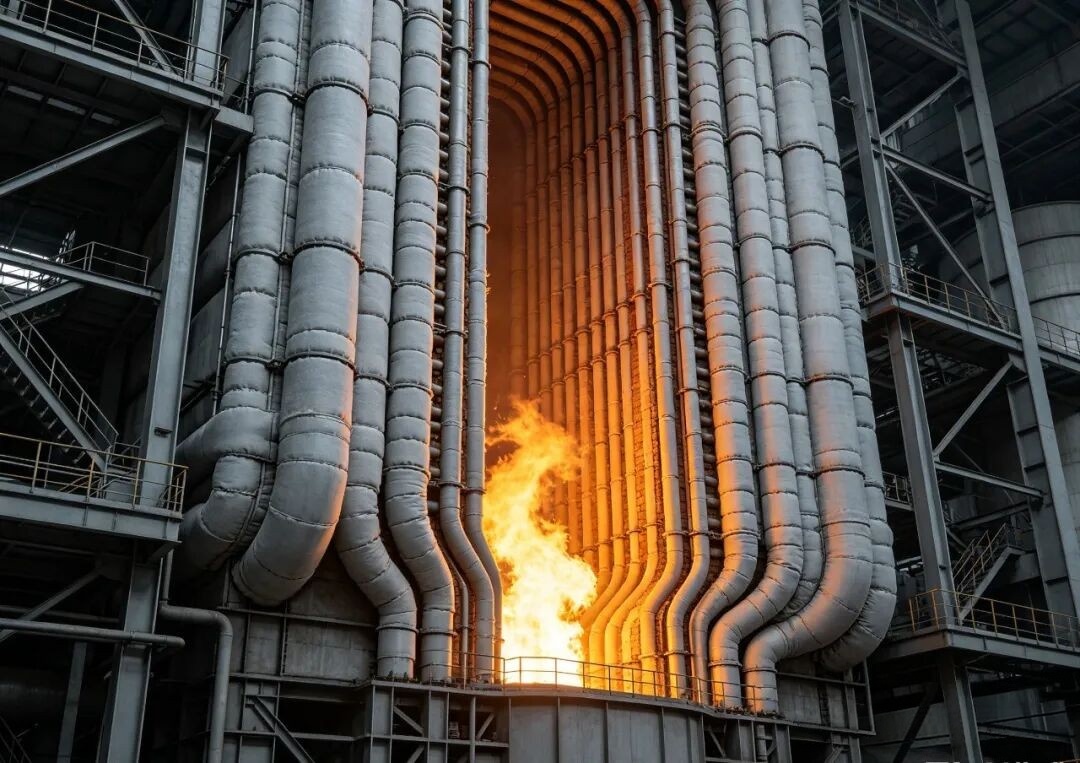
The water‑wall serves as the core heating surface of the waste‑to‑energy boiler. It is constructed by welding numerous seamless steel tubes with steel strips to form membrane water‑wall panels, which line the entire perimeter of the furnace. Waste is combusted inside the furnace generating high temperatures up to over 1 000 °C. Through thermal radiation, the water‑wall tubes transfer heat to the water flowing inside the tubes. The internal water turns into steam to drive the steam turbine for power generation. Meanwhile, heat removal cools down the furnace structure. However, waste contains PVC plastics and salts from kitchen residues. The flue gas is loaded with HCl, alkali‑metal chlorides and fly ash, which cause chlorine‑induced high‑temperature corrosion. Tube wall thinning and tube rupture are frequent failures. Therefore, the water‑wall tubes require a high‑temperature anti‑corrosion coating for protection.

Powder Material: Inconel 625
Main composition (wt%): Ni balance, 21.5Cr, 9Mo, 3.6Nb, low Carbon.
Powder features: Excellent chlorine‑resistance, good high‑temperature strength, erosion resistance, medium crack sensitivity.
Dilution rate control: 2%‑5%. Avoid massive Fe dilution from base material into coating which degrades corrosion resistance.

Note: Alloy 59 is more widely adopted in Europe:
Main composition (wt%): Ni balance, 23Cr, 16Mo, ultra‑low Carbon, no Niobium (Nb).
Powder features: Superior chlorine‑corrosion resistance compared to Inconel 625.High Molybdenum (Mo) content provides good resistance against molten chloride salt corrosion. Suitable for severely corroded zones (strongly corrosive upper‑middle furnace chamber areas). Higher material cost than Alloy 625.
Dilution rate control: 2%‑5%. Prevent excessive Fe dilution from base material into the coating, which would impair corrosion resistance.
Coating thickness: 0.4‑0.7 mm.
Process Parameters:
Laser Power: 5600 W
Travel Speed: 2 m/min
Powder Feed Rate: 35 g/min (co‑axial powder feeding)
Shielding Gas (Argon) Flow Rate: 18 L/min
No pre‑heating required
Overlap Rate: 50 %
Effective Coating Thickness: 1.0‑1.1 mm (single pass)
Target Dilution Rate: 2‑4 % (Fe content in coating ≤5 wt%. If dilution rate exceeds 5 %, chlorine corrosion resistance drops significantly. Excessively low dilution will result in poor metallurgical bonding.)
Notes:
Substrate pre‑treatment shall be performed prior to laser cladding:
Grinding / sandblasting to Sa2.5 standard to remove scale, loose rust and carbon deposits on tube surface. Oil contamination and moisture on tube surface are strictly prohibited.
Non‑destructive testing shall be carried out after cladding: PT (penetrant testing). Continuous cracks and clustered porosity are not permitted.
Isolated small pores ≤0.2 mm are acceptable in limited quantity.
Thickness inspection: Measure section‑by‑section using coating thickness gauge. Local minimum thickness shall not be less than 80 % of the designed value. Components failing inspection shall not be put into service.
Dilution rate: Units with dilution rate >5 % are forbidden for service.
Laser cladding machine video:
Xian Yunding laser Technology Co., Ltd. is a professional factory in the laser cladding and hardening area in China. Our machine has been widely used in many industries such as coal mining machinery, metallurgical machinery, agricultural machinery, petroleum machinery, cutting teeth/shovel teeth, Automotive, injection molding machinery, valve industry, mold industry, power industry, bearing/bushing/shaft sleeve and repairing.
In the Chinese application market, we Yunding Laser has the highest market share.
We can provide the turnkey engineering project service for your needs.
For more information about this laser cladding machine please visit:
www.ydlasertech.com
whatsapp:+86-13851850644
Email: yundinglaser@gmail.com