


Do you know why glass mold require laser cladding processing?
Glass molds are in long‑term contact with molten glass at around 1100 °C, undergoing repeated thermal cycles. They are subject to high‑temperature oxidation, thermal‑fatigue cracking, chemical corrosion by molten glass, and frictional wear on parting surfaces. Cast‑iron / copper‑alloy substrates cannot withstand such working conditions. They tend to suffer from surface spalling, thermal cracking and cavity wear, which causes scratches, pitting and flash defects on glass bottles / glassware, leading to frequent mold scrapping.
Laser cladding deposits high‑temperature‑resistant nickel‑based / cobalt‑based alloy coatings on key positions including mold cavities, parting surfaces, plungers and neck rings. Its core benefits are shown below:
Solve four major failure modes
- Resist thermal fatigue and suppress thermal cracks Each blow‑molding cycle brings rapid heating and cooling, which easily generates network‑like thermal cracks on the mold surface. Laser‑clad coatings feature fine microstructures, good thermal‑shock resistance and can delay crack initiation and propagation.
- High‑temperature oxidation resistance and molten‑glass corrosion resistance Alkaline components inside molten glass corrode mold substrates. The dense cladding alloy layer isolates high‑temperature oxidation and chemical attack, preventing surface spalling and peeling.
- Improved wear resistance to protect parting surfaces and cavities Friction from mold opening‑closing and glass material causes wear and collapse on parting lines and mold orifices. The cladding layer can reach HRC 58‑65, greatly reducing the wear rate.
- Better mold‑release performance and improved appearance of glass products The dense coating has extremely low porosity, reduces mold sticking, lowers pitting and streak defects on glass bottles and raises the finished‑product yield.
Advantages compared with conventional hardfacing / spraying processes
- Metallurgical bonding without peeling: The coating fuses with the substrate. Thermal spraying only provides physical adhesion and is prone to spalling.
- Low heat input and minimal mold distortion: Most glass molds are made of cast iron or copper alloy. Arc hardfacing delivers high heat input and easily causes deformation and cracking. Laser cladding creates a tiny heat‑affected zone with small post‑processing allowance, reducing subsequent machining and polishing work.
- Localized strengthening: Cladding is applied only to worn areas such as cavities and parting surfaces instead of the whole mold, saving costly high‑temperature alloy powder.
- Refurbishment of used molds: Worn‑out scrap molds can be repaired by laser cladding to restore cavity dimensions, replacing new molds and cutting procurement costs. Service life is generally increased by 2‑3 times, and up to 3‑4 times under certain working conditions.
Typical application areas
Wear‑prone glass‑mold components: blank molds, blow molds, neck ring, bottom plates, plungers, neck ring guides and Baffles.
Conventional flame spray‑welding and plasma hardfacing generate high heat input, which readily triggers cracking and deformation of cast‑iron molds. Thermal‑spray coatings have poor bonding strength and may peel off during production and contaminate glass products. Therefore, laser cladding is increasingly adopted to strengthen critical surfaces of cast‑iron glass molds.
Glass mold: Plunger


Our laser cladding machine for glass mold – plunger


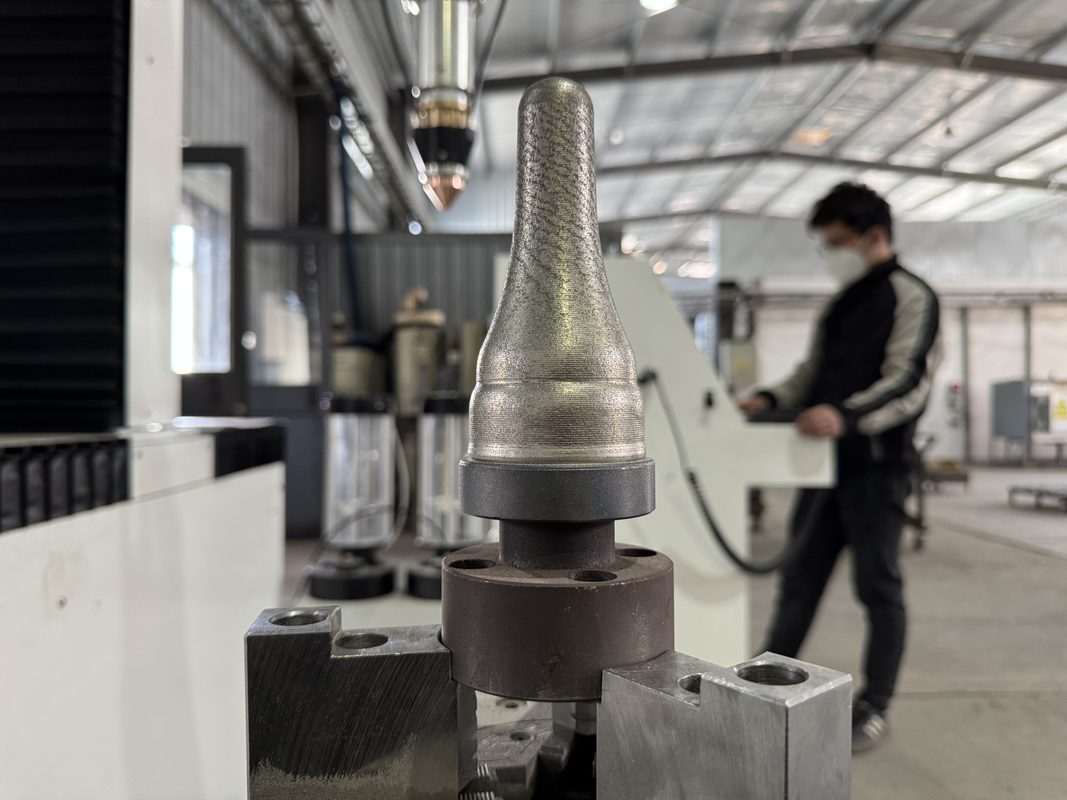
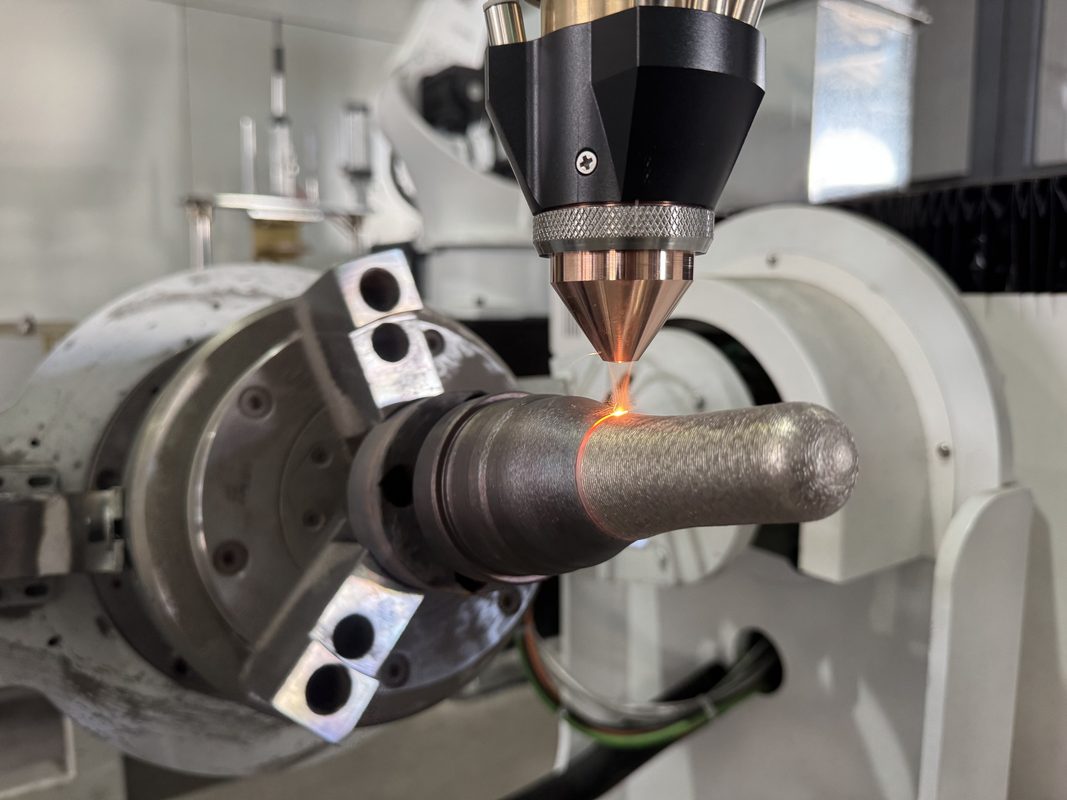
information about our glass mold laser cladding machine:
This laser cladding machine is the CNC Based machine, it has 5 axis: X-axis, Y-axis, Z-axis, A-axis and C-axis. These 5 axis can work in linkage.
we can programe the laser cladding path manually using G-code. Also, we can send the NC Code via internect cable.

This machine can perform the laser cladding for the blank mold, blow mold, Neck ring, Neck ring guide, plunger, baffle, bottom plate and so on.
Machines based on CNC systems have significant technical advantages over robot‑based machines:
- Flexible programming options. Manual programming is supported, and mainstream CAD/CAM software (such as UG, Mastercam, Powermill, etc.) can also be used for assisted programming. CAD/CAM‑assisted programming enables fast completion of laser cladding tasks for complex molds.


2. With CNC‑based machines, it is easy for enterprises to source qualified operators, who can become proficient in operation within a very short period.
Laser cladding Processing:
Powder:
Ni-50 (Nickel‑based self‑fluxing powder for glass mold laser cladding)
Typical chemical composition (wt%): C: 0.08‑0.16%, Cr:4.0‑6.0%, Si:2.4‑3.2%, B:0.8‑1.3%, Fe ≤3.5%, Ni: Balance.
Coating hardness: HRC 48‑50.
Character:Gas‑atomized spherical powder. Good wear‑resistance and corrosion‑resistance, lower cracking tendency
| Element | Ni | Cr | B | Si | Fe | C |
|---|---|---|---|---|---|---|
| wt% | Balance | 14‑17 | 3.0‑4.0 | 3.5‑4.5 | ≤5 | 0.6‑0.9 |
Laser Cladding Process Parameters for Glass Mold Plunger:
a. Substrate: Glass mold punch made of grey cast iron / alloy cast iron;
b. Co‑axial powder feeding, punch rotation, spiral scanning path;
c. Low dilution rate, minimum porosity, crack suppression. Single‑layer thickness: 0.4‑0.6 mm; total coating thickness: 0.8‑1.2 mm, followed by machining and polishing.
d. Laser power: 2400 W (2100 W for punch head)
e. Workpiece rotational linear speed: 1200 mm/min
f. Powder feed rate: 25 g/min
g. Overlap rate: 40%
h. Cladding thickness: 0.6 mm
j. Dilution rate: 5%
k. Workpiece pre‑treatment: Grind / sand‑blast the cladding area of punch to remove scale, oil contamination and carburized layer.
Video about the Plunger laser cladding:
We can provide the turn-key engineering service for the glass mould laser cladding machine
Xian Yunding Laser Technology Co., Ltd. is a professional factory in the laser cladding and hardening area in China. Our machine has been widely used in many industries such as coal mining machinery, metallurgical machinery, agricultural machinery, petroleum machinery, cutting teeth/shovel teeth, Automotive, injection molding machinery, valve industry, mold industry, power industry, bearing/bushing/shaft sleeve and repairing.
In the Chinese application market, we Yunding Laser has the highest market share. We can provide the turnkey engineering project service for your needs.
More information please visit: www.ydlasertech.com
whatsapp:+86-13851850644
Email: yundinglaser@gmail.com or John@ydlasertech.com
Yunding laser is committed to supplying high‑quality laser cladding machines for the industry.